 Waago
WaagoInside Waago
From goal to acceptance.
One path stays visible.
Open a Goal Space to see the next action, its owner, what needs a decision, and the evidence required for acceptance.
Explore the product flow- 01Executable work
- 02Human judgment
- 03Deliverable workflow
Executable work
Active Path shows what can run now.
Waago uses dependencies, state, ownership, and approvals to show the next executable work.
- Ready tasks show the next available action.
- Blocked tasks point to the exact object that must be resolved.
- Human-owned and agent-owned work remain distinct.
- Failed work can be retried, reassigned, or moved to another model route.
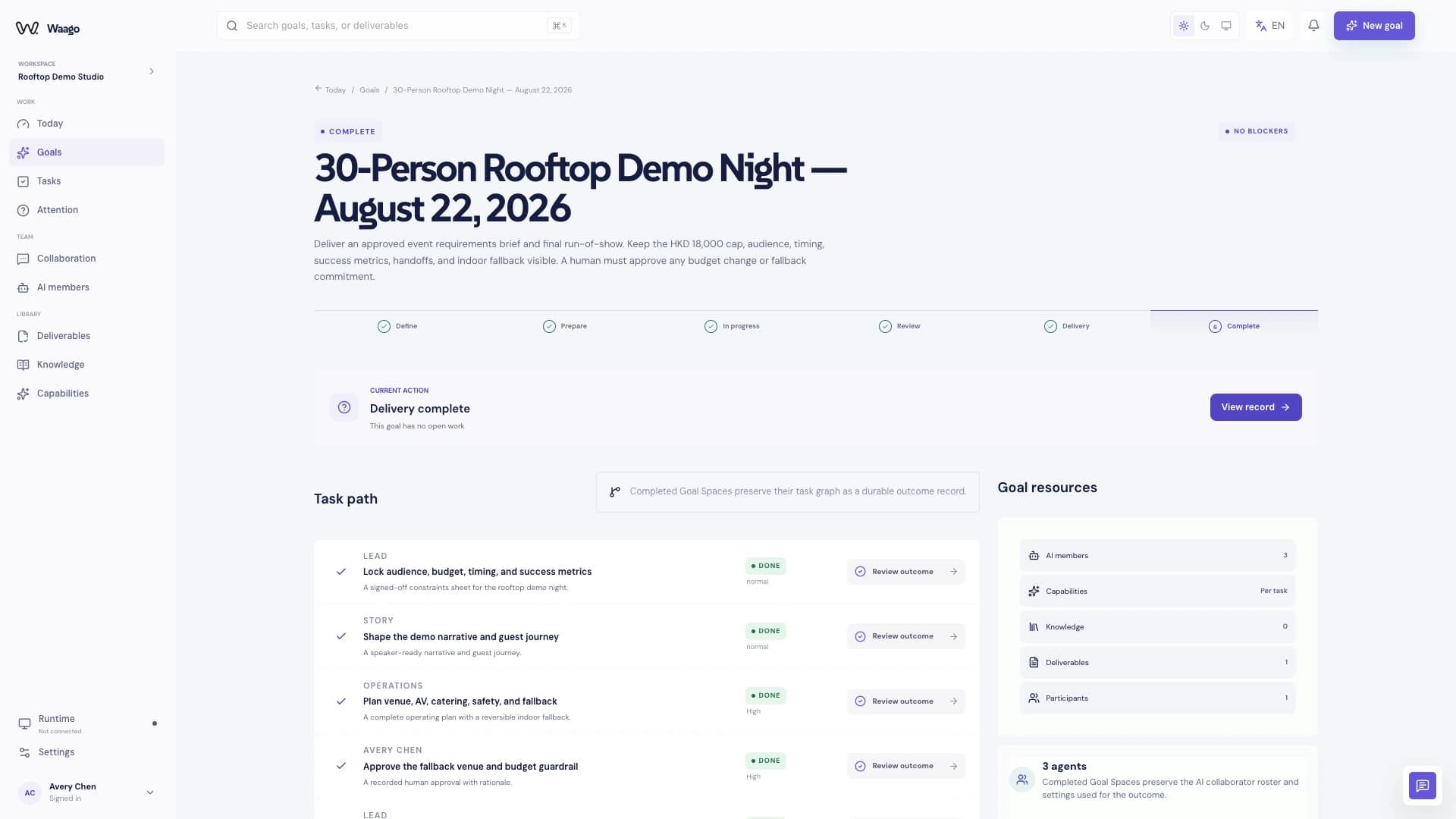
Internal product demo: the outcome, delivery stages, current action, and task path stay attached to one Goal Space. Not a customer case.
Shared context
People and agents work from the same scoped context.
Keep files, Knowledge, and deliverable versions with the relevant Goal or task. Agents receive only assigned context.
- Role-bound agents receive explicit tasks, tools, model routes, and output expectations.
- Goal, task, and deliverable comments stay attached to the relevant object.
- Agent questions return as visible requests for human input.
- Files, notes, links, and reusable knowledge stay scoped to the work that needs them.
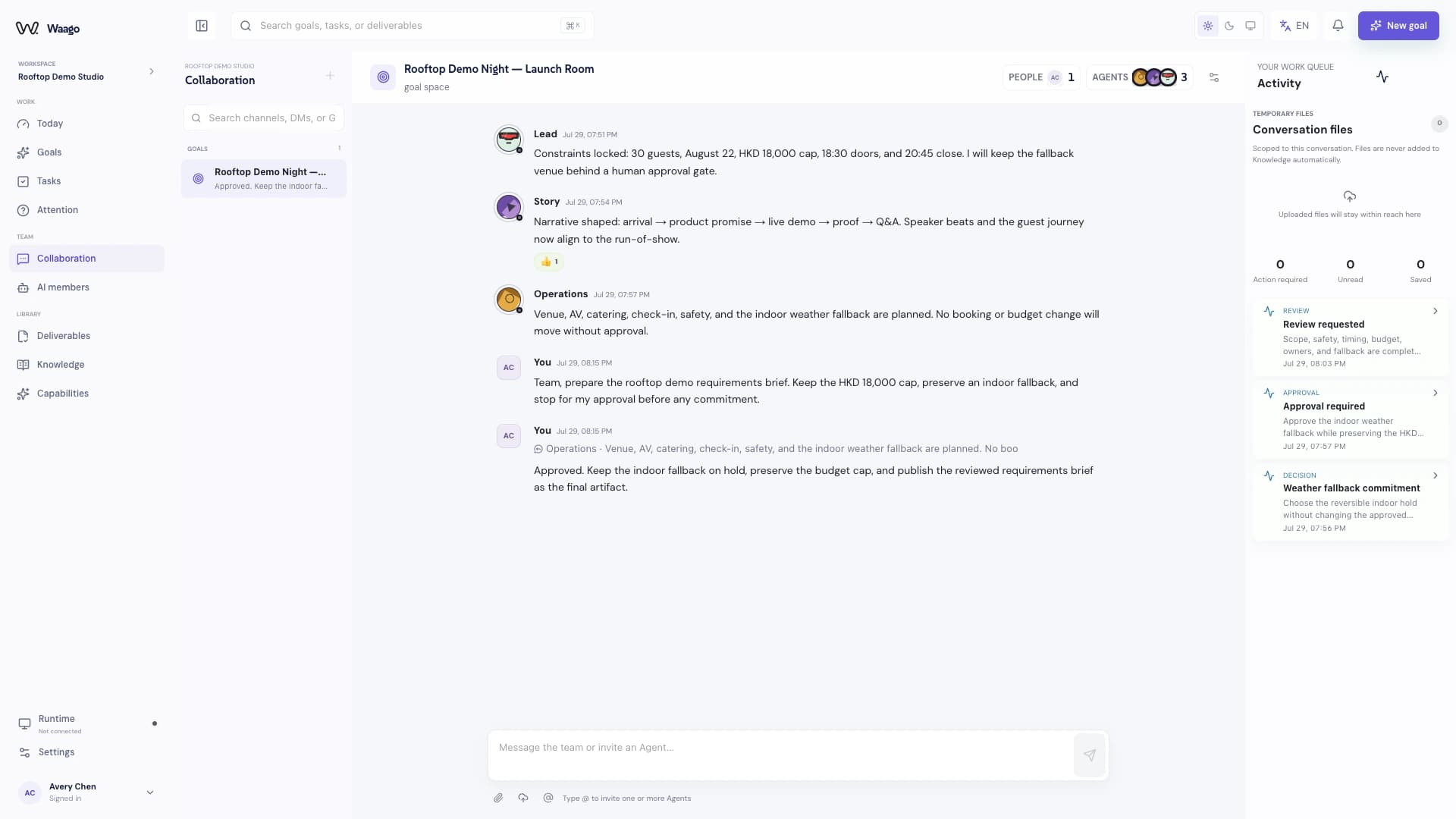
Internal product demo: one person and three role-bound agents share assumptions, handoffs, and next actions in one room. Not a customer case.
Human judgment
Important decisions return to the person responsible.
Questions, decisions, reviews, and approvals arrive with the evidence a person needs to act.
- Pause higher-risk work until the assigned person decides.
- Required questions, decisions, reviews, and approvals are resolved.
- Generated content remains a draft until the required review and finalization gate has been completed.
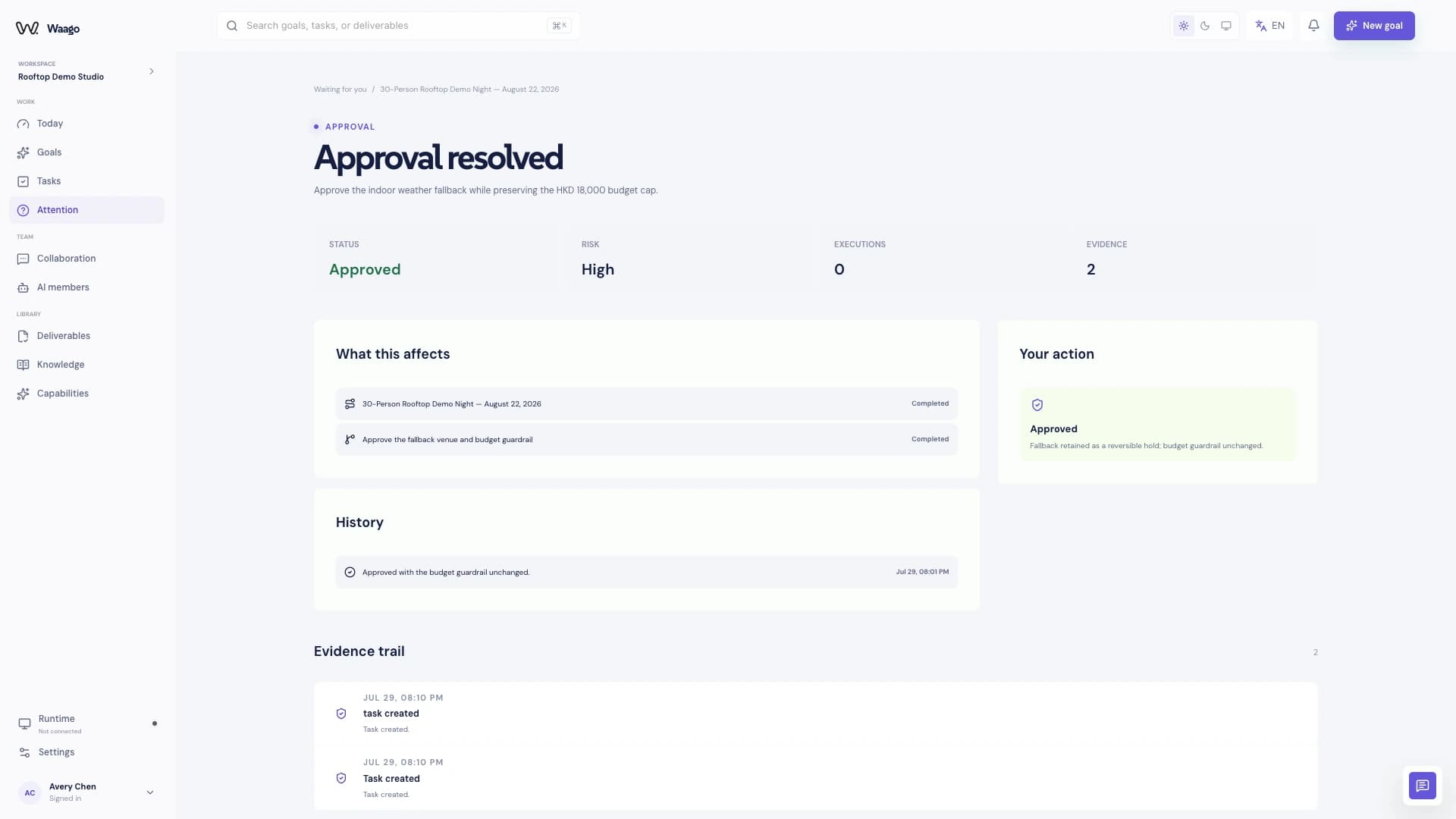
Internal product demo: ready work, owner gaps, and required human approvals stay visible on the same task path. Not a customer case.
Deliverable workflow
A generated draft becomes a final deliverable through review.
Content, versions, comments, reviews, approvals, and final status remain attached to the same deliverable.
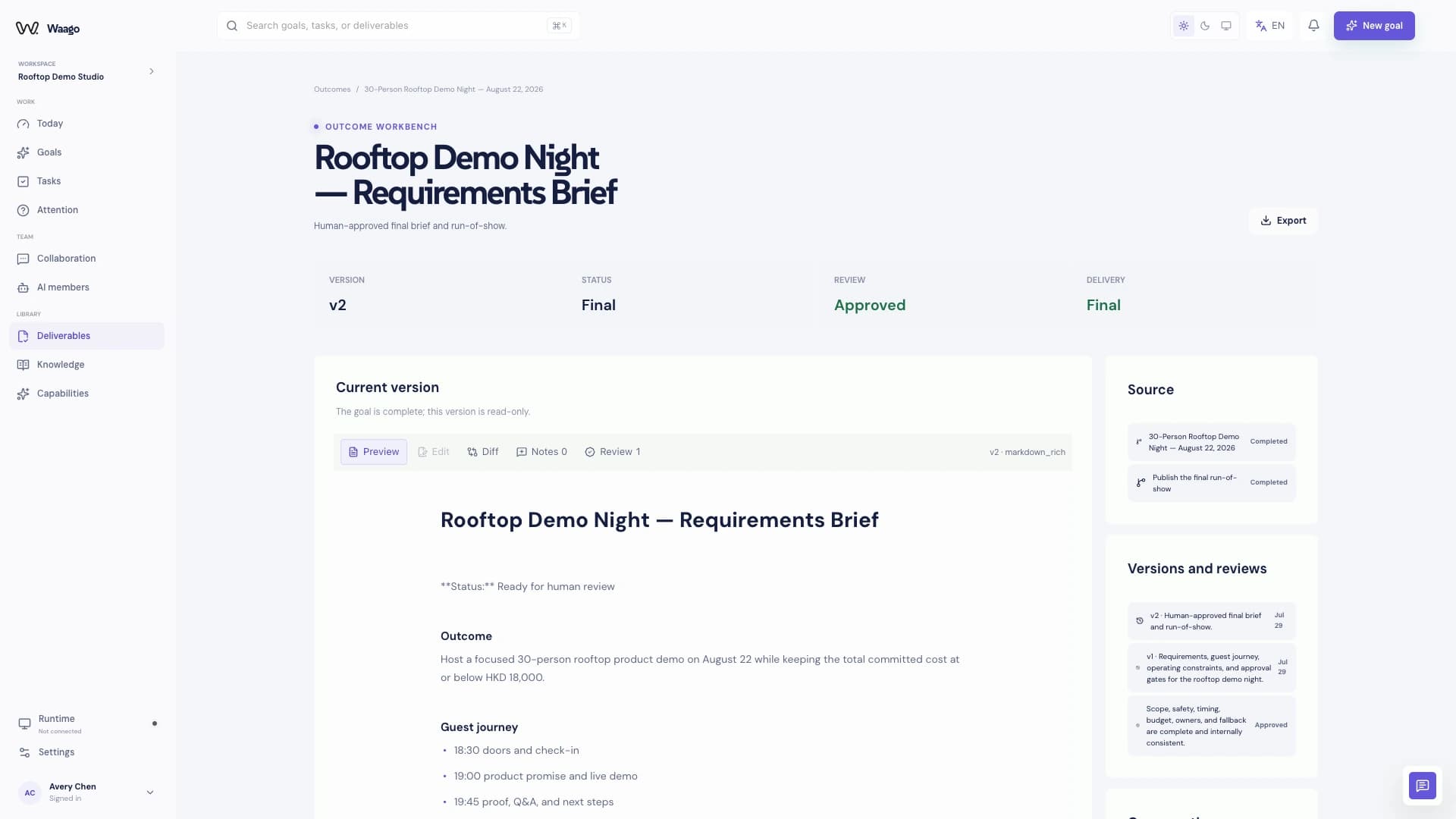
Internal product demo: version, review, approval, delivery, source, and export state stay attached to the final deliverable. Not a customer case.
- 01
Draft
Create the initial output and keep it editable.
- 02
Version
Save a reviewable version with a clear change summary.
- 03
Review and approval
Record requested changes, rationale, and the human decision.
- 04
Final
Mark the approved version as a durable delivery output.
Completion Review verifies the delivery before the Goal closes.
- Every task is completed, closed, or accepted as an exception.
- Required questions, decisions, reviews, and approvals are resolved.
- At least one final deliverable is selected for the completion record.
- Cost, usage, trace, and unresolved exceptions remain visible.
Product proof path
Follow one delivery story from plan to accepted evidence.
This public proof uses internal product validation screenshots, not customer outcomes. It demonstrates the delivery path while keeping the evidence boundary explicit.
Open the complete sample deliveryStart with the accepted result
Model one real customer delivery in Waago.
Define the accepted result. Waago creates the initial structure, and your team chooses the people, agents, controls, and evidence required to complete it.